Honouring the Brave: Celebrating Kargil Vijay Diwas Through Craft, Fuel & History
A Hands-On Patriotic Activity Guide for Kids, Families & Classrooms
By Tina Khatri • tinakhatri.in

Why This Sunday Matters
As India prepares to observe Kargil Vijay Diwas this coming Sunday, we remember the extraordinary valour, resilience, and supreme sacrifice of the Indian Armed Forces who defended the nation's highest peaks in 1999. Commemorating this monumental day goes beyond remembrance — it is about actively connecting the next generation to the spirit of operational readiness, teamwork, and tactical endurance that defined Operation Vijay.
For many children today, the Kargil War is a chapter in a history textbook — a collection of dates, names, and maps that feel distant and abstract. But for the soldiers who scaled those sub-zero ridges, for the families who waited by the door, and for a nation that held its breath through those 60 harrowing days in the summer of 1999, Kargil was anything but distant. It was raw, real, and deeply personal.
That is why this activity guide exists. It is designed to bridge the gap between history and heart — to help children, parents, and educators transform a historical milestone into an immersive, knowledgeable tribute to our frontline heroes. Through three carefully designed activities — a geometric origami craft, a survival-inspired recipe, and a narrative fill-in-the-blank story — young minds will not just learn about Kargil. They will feel it.
Three Activities, One Powerful Story
To bridge history with hands-on engagement ahead of Sunday's observance, three distinct activities come together to tell the Kargil story:
Together, these elements transform a historical milestone into an immersive, knowledgeable tribute to our frontline heroes. Each activity connects to a different aspect of the Kargil story: the craft represents unity, the recipe represents survival, and the story represents sacrifice.
The Story of Kargil: What Happened in 1999?
Before diving into the activities, it is important to understand what we are commemorating. The Kargil War was not a large-scale invasion. It was a stealth operation — an infiltration of Pakistani soldiers and militants who crossed the Line of Control (LoC) under the cover of winter and occupied strategic peaks on the Indian side of the border in the Kargil district of Ladakh.
When Indian patrol teams discovered the infiltration in early May 1999, the situation was dire. The enemy held the high ground — peaks at altitudes of 16,000 to 18,000 feet, with steep, icy cliffs that offered no cover and no easy path up. Indian soldiers had to fight gravity, frostbite, altitude sickness, and relentless enemy fire, all at the same time.
The terrain was brutal beyond what most civilians can imagine. Temperatures plunged to minus 30 degrees Celsius. The air was so thin that soldiers could barely breathe, let alone fight. Every step uphill felt like wading through cement. And the enemy, perched on ridges above, had a clear line of sight to every movement below. It was, by every measure, one of the most lopsided battlefield positions in modern warfare.
Operation Vijay: The Military Response
The Indian Armed Forces launched Operation Vijay to recapture the occupied peaks. It was one of the most challenging mountain warfare operations in modern military history. Soldiers from the Indian Army, supported by the Indian Air Force's Operation Safed Sagar and the Indian Navy's Operation Talwar, fought for nearly 60 days in some of the harshest terrain on earth.
Operation Safed Sagar, the air component, was particularly groundbreaking. Indian Air Force jets flew sorties at altitudes never attempted before in combat, dropping laser-guided bombs on enemy positions while flying through narrow valleys to avoid radar detection. The coordination between ground and air forces was a masterclass in joint military operations.
Operation Talwar, the naval component, blockaded the Pakistani coast to cut off supplies and reinforcements. While the world's attention was fixed on the mountains, the Indian Navy quietly ensured that the enemy's supply lines were choked — a strategic move that proved decisive in the long run.
The turning point came on July 4, 1999, when Indian forces recaptured Tololing, one of the key peaks. This was followed by the legendary battle for Tiger Hill on July 5–6, and the capture of Point 5140 by Lieutenant Vikram Batra, whose famous battle cry “Yeh Dil Maange More!” became the defining words of the operation.
By July 26, 1999, India had officially recaptured all infiltrated positions. The nation declared victory. But the cost was immense: 527 Indian soldiers laid down their lives defending the peaks. Their sacrifice is why we observe Kargil Vijay Diwas every year on July 26.
A Timeline of Courage
Activity 1: Kargil Vijay Chakra — Modular Origami Star

Why an Origami Star?
The Kargil Vijay Chakra is not just a paper star. It is a symbol. Each of the 6 units represents a value that defined the soldiers at Kargil: courage, unity, sacrifice, discipline, resilience, and honour. When individual units are assembled into a single star, they lock together — just as the Indian Army, Navy, and Air Force locked together during Operation Vijay. One piece alone is fragile. All six together form something unbreakable.
Making this star teaches children about geometric precision, spatial reasoning, and the power of working together — all while creating a beautiful, patriotic decoration they can proudly display.
Materials You Will Need
Gather These Supplies
- 6 to 12 square sheets of origami paper (3v″×3v″ or 6v″×6v″)
- Use saffron, white, and green paper to match the Indian tricolour — or gold and silver for a regal touch
- A flat, clean surface to fold on
- Optional: glue stick for extra stability (traditional modular origami does not need glue)
Step-by-Step Instructions
- Step 1 — Centre Crease: Fold one square sheet in half horizontally, then unfold. This creates a clean centre guideline that every subsequent fold references. Accuracy here determines how well the final star locks together.
- Step 2 — Cupboard Fold: Fold the top and bottom edges to the centre line to form a neat rectangle. Unfold to leave visible crease lines. These creases are your blueprint for the next step.
- Step 3 — Diagonal Corners: Fold the top-left corner down and the bottom-right corner up to meet the crease lines. This creates a parallelogram shape. The diagonal folds are what give the star its dynamic, angular appearance.
- Step 4 — Tucking Flaps: Fold the triangular flaps over the central rectangular layer. This forms pockets and flaps — the interlocking mechanism that holds the star together without glue. Each unit now has a flap that slides into the pocket of the next unit.
- Step 5 — Repeat: Repeat Steps 1 through 4 for all 6 sheets. Consistency is key — each unit should be identical in size and fold precision. If you are using tricolour paper, make 2 saffron, 2 white, and 2 green units.
- Step 6 — Assemble: Slide the flap of one unit into the pocket of the next, working in a circle. Continue until all 6 units are connected. The final unit’s flap tucks into the first unit’s pocket, locking the entire structure into a 3D star. Gently press and adjust until the star is symmetrical.
The Science Behind the Star
Modular origami is a form of mathematical art. The star uses principles of symmetry, rotational geometry, and friction-based interlocking. When children fold and assemble these units, they are engaging with concepts that appear in engineering, architecture, and physics. The fact that 6 flat pieces of paper can lock together into a rigid 3D structure without any adhesive is a powerful demonstration of how geometry creates strength — a principle that applies to bridges, buildings, and yes, military formations.
Activity 2: High-Energy Nut & Date Energy Bites

Why Energy Bites?
At 16,000 feet above sea level, the air is thin, the temperature drops well below freezing, and every calorie matters. During Operation Vijay, Indian soldiers survived on high-density, lightweight rations that could be eaten without cooking — because lighting a fire at those altitudes, under enemy observation, could be fatal. Dates, nuts, dried fruits, and energy bars were not just food. They were fuel for survival.
This recipe recreates that spirit of field sustenance in a form that children can make at home. The combination of dates (natural sugar and binding), nuts (protein and healthy fats), seeds (minerals), and oats (slow-release energy) creates a dense, satisfying bite that mirrors the nutritional density soldiers needed.
Ingredients
What You Need
- 1 cup pitted dates (soft, Medjool dates work best — they act as the natural glue)
- ½ cup mixed nuts (almonds, cashews, walnuts — roughly chopped for texture)
- ¼ cup seeds (pumpkin seeds or sunflower seeds for crunch and minerals)
- 2 tbsp peanut butter or almond butter (adds protein and helps bind the mixture)
- 2 tbsp rolled oats (slow-release carbohydrates for sustained energy)
- 1 tbsp honey or jaggery (natural sweetness and additional binding)
- Pinch of cardamom or cocoa powder (for flavour — cardamom for an Indian touch, cocoa for a modern twist)
Instructions
- Chop: Roughly chop the mixed nuts into small, uneven pieces. You want texture, not powder. The variation in size creates an interesting bite — some crunchy, some smooth.
- Blend: Place the pitted dates in a food processor and pulse until they form a thick, sticky paste. Do not over-blend — you want a dense paste, not a smooth puree. If the dates are dry, add a teaspoon of warm water.
- Mix: In a large bowl, combine the date paste, chopped nuts, seeds, oats, peanut butter, and your chosen spice (cardamom or cocoa). Stir until everything is evenly distributed.
- Knead: This is the most important step. Use your hands to knead the mixture thoroughly, pressing and folding it into a dense, uniform dough. The heat from your hands will soften the dates further, helping everything bind. If the mixture is too dry, add a tiny bit more honey. If too wet, add a tablespoon more oats.
- Shape: Pinch off small portions and roll them between your palms into bite-sized balls (about 1 inch in diameter). Alternatively, press the entire mixture into a lined tray and cut into bars once chilled.
- Chill: Place the shaped bites on a plate lined with parchment paper and refrigerate for at least 30 minutes. This firms them up and makes them easy to store and pack.
The Nutritional Science
Every ingredient in this recipe serves a purpose that mirrors military ration science:
- Dates: Nature’s energy bar. Rich in natural sugars (glucose and fructose) for quick energy, plus fibre for sustained release. At high altitudes, where the body burns calories faster, dates were a staple of military field rations.
- Nuts (almonds, cashews, walnuts): Dense sources of healthy fats, protein, and micronutrients. They provide long-burning fuel — the kind of energy that keeps you going for hours, not minutes.
- Seeds (pumpkin, sunflower): Packed with magnesium, zinc, and iron — minerals that support muscle function, immune health, and oxygen transport. At high altitudes, where oxygen levels drop, these minerals are critical.
- Peanut butter: A double-duty ingredient: it adds protein (for muscle repair) and acts as a binding agent (helping the bites hold their shape).
- Rolled oats: Complex carbohydrates that release energy slowly and steadily — exactly the kind of fuel a soldier (or a student) needs for sustained performance.
- Honey/Jaggery: Natural sweeteners that also contain trace minerals and antioxidants. Unlike refined sugar, they provide energy along with nutritional value.
Activity 3: Operation Vijay — The Battle for the Peak
A Story of Courage
This fill-in-the-blank narrative brings the Kargil story to life through the eyes of a young officer leading his platoon up a frozen mountain under enemy fire. Read it aloud, fill in the blanks using the word bank below, and feel the tension, the bravery, and the triumph of those who fought for every inch of ground on those icy peaks.
Word Bank
Use These Words to Fill the Blanks
26 • Tiger Hill • Vikram • Vajra • Sat Sri Akaal • Yeh Dil Maange More! • Tiranga • Immortal
The Narrative
The wind howled bitterly across the freezing ridges of Kargil. It was July 1. ________ , 1999, as the Indian Army set out to recapture 2. ________ .
Lieutenant 3. ________ adjusted his backpack, looking at his determined platoon. Their code name was 4. ________ .
Under darkness, they scaled sheer, icy cliffs. Suddenly, enemy flares turned the night to daylight amid heavy machine-gun fire.
“Bole So Nihal, 5. ________ !” shouted a rifleman, charging forward.
Inspired by cries like 6. ________ , Lieutenant 3. ________ led his men through the barrage to outflank the enemy bunker.
With a final push, they neutralized the post and planted the 7. ________ proudly at the peak. The victory and supreme sacrifices on Kargil Vijay Diwas ensured their legacy remains 8. ________ .
Answer Key
★ Operation Vijay — Answers Revealed
- 1. 26 (July 26, 1999 — the day India declared victory)
- 2. Tiger Hill (or Tololing — the key peaks recaptured)
- 3. Vikram (Lieutenant Vikram Batra, Param Vir Chakra awardee)
- 4. Vajra (or Tiger — the code name for the operation unit)
- 5. Sat Sri Akaal (the Sikh war cry meaning “God is truth”)
- 6. Yeh Dil Maange More! (Vikram Batra’s legendary battle cry)
- 7. Tiranga / Tri-colour (the Indian national flag)
- 8. Immortal / Legendary (the enduring legacy of the Kargil heroes)
Test Your Knowledge: Kargil Vijay Diwas Quiz
How well do you know the story of Kargil? Take this quick 8-question quiz to find out. Click on your answer for each question — the correct answer will turn green. Your score appears at the bottom.
1. In which year did the Kargil War take place?
2. What was the code name for the Indian military operation to recapture Kargil?
3. On which date is Kargil Vijay Diwas observed every year?
4. Which peak was recaptured first, marking a turning point in the war?
5. What was Captain Vikram Batra’s famous battle cry?
6. How many Indian soldiers were martyred during the Kargil War?
7. Which was the Air Force operation during the Kargil War?
8. What is the Param Vir Chakra?
The Legend of Captain Vikram Batra
A Hero for the Ages
No tribute to Kargil Vijay Diwas is complete without remembering Captain Vikram Batra — the officer whose name has become synonymous with valour, selflessness, and the indomitable spirit of the Indian Army.
Born on September 9, 1974, in Palampur, Himachal Pradesh, Vikram Batra was a brilliant student and a natural leader. He joined the Indian Military Academy and was commissioned into the 13 Jammu & Kashmir Rifles. When Operation Vijay was launched, Captain Batra was at the forefront.
On the night of July 5–6, 1999, Captain Batra led his men up the treacherous slope of Point 5140 (part of the Tiger Hill complex). Under relentless enemy fire, through icy cliffs and near-total darkness, he and his platoon reached the enemy bunker. In close-quarters combat, Captain Batra killed several enemy soldiers and recaptured the peak.
As the operation was being wound down, Captain Batra was told that one of his fellow officers was stranded and wounded. Without hesitation, he went back into enemy territory to rescue him. During this selfless act, he was hit by enemy fire and made the supreme sacrifice. He was just 24 years old.
Captain Vikram Batra was posthumously awarded the Param Vir Chakra — India’s highest wartime gallantry award. His famous words, “Yeh Dil Maange More!” (This heart asks for more!), originally borrowed from a Pepsi advertisement, became the battle cry of a generation and a symbol of the Indian soldier’s refusal to settle for anything less than total victory.
His twin brother, Vishal Batra, has since dedicated his life to preserving Vikram’s legacy, speaking at schools and institutions across the country. Through Vishal’s efforts, Captain Batra’s story continues to inspire millions of young Indians who might otherwise never know the depth of sacrifice behind the freedom they enjoy today.
Bonus Activity: India Military Connect-the-Dots
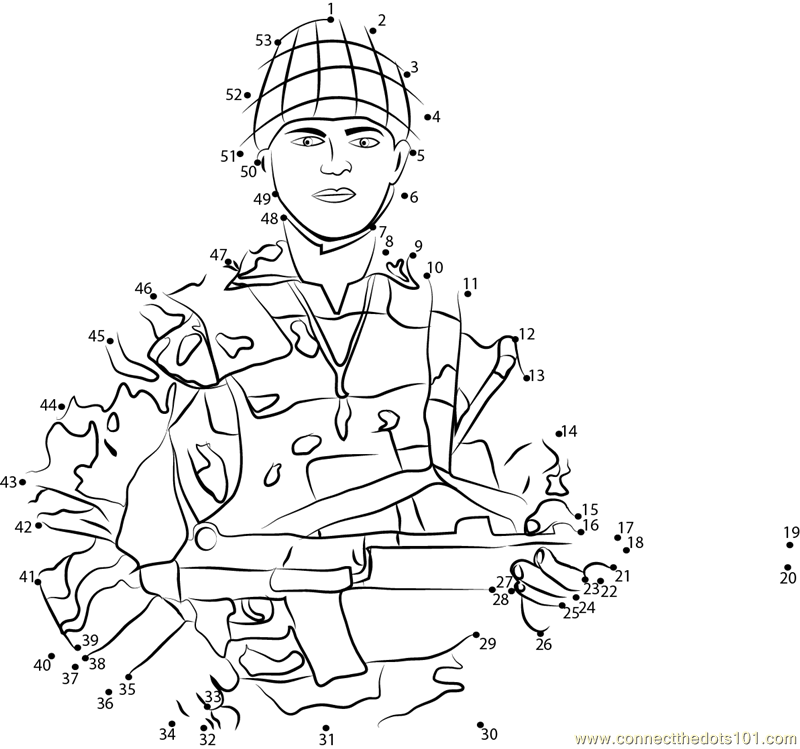
A Fun Way to Learn
This connect-the-dots activity is a wonderful addition for younger children (ages 4–8). As they draw lines from number to number, an image of India’s military equipment or soldiers takes shape. Connect-the-dots activities help children practice number sequencing, fine motor skills, and concentration — all while engaging with a patriotic theme.
How to use: Print the image (right-click and save, then print), hand it to your child along with crayons, and let them connect the dots in order. Once the picture is complete, they can colour it in the Indian tricolour — saffron, white, and green.
How to Use This in a Classroom or at Home
For Teachers: A Complete Lesson Plan
Duration: 45–60 minutes
Phase 1 — Introduction (10 minutes)
Begin with a brief discussion: “What do you know about Kargil? Why do we celebrate Kargil Vijay Diwas?” Use the timeline above to walk through the key events. Show the images if possible. Let children ask questions.
Phase 2 — The Craft (15–20 minutes)
Distribute the origami paper and walk the class through the 6 steps. For younger children, pre-fold the units and focus on the assembly. While folding, discuss: “Why do you think each piece needs to be identical? What happens when one piece is different?” This naturally leads to a conversation about teamwork and unity.
Phase 3 — The Recipe (5 minutes discussion, extend as homework)
Show the recipe and discuss the nutritional science behind each ingredient. Connect it to the soldiers’ reality: “Imagine eating only dates and nuts for weeks, at a place where water boils at 70°C and your fingers are too numb to hold a spoon. That is what our soldiers endured.” Send the recipe home as a family activity.
Phase 4 — The Story (10–15 minutes)
Read the fill-in-the-blank narrative aloud as a class. After each blank, discuss the answer and its significance. The blanks are designed to spark conversation, not just test memory. When students reach blank 6 (“Yeh Dil Maange More!”), explain the story behind the phrase.
Phase 5 — Reflection (5 minutes)
End with a quiet moment. Ask students to write one sentence: “The Kargil hero I will remember most is _____ because _____.” Collect these and display them on a “Wall of Honour” in the classroom.
For Parents: Making It a Family Experience
You do not need a classroom to make this meaningful. Here is how to turn it into a powerful family activity this Sunday:
- Start with the story. Read the fill-in-the-blank narrative together. Let your child try to guess the answers. Explain who Vikram Batra was and why his story matters.
- Make the craft together. Fold the origami units side by side. While folding, share stories of courage you admire — from Kargil or from everyday life.
- Cook the energy bites together. Let your child measure, mix, knead, and roll. While they do, talk about how soldiers prepared their food in extreme conditions.
- Display the star. Hang the finished origami star in a place of honour — the living room wall, the study desk, or the kitchen window. Let it serve as a daily reminder of courage and unity.
- Print the connect-the-dots for younger siblings and let everyone participate at their own level.
Extended Learning: Going Deeper
Vocabulary From the Kargil Story
| Word | Meaning |
|---|---|
| Valour | Great courage in the face of danger |
| Infiltration | Sneaking into enemy territory without being detected |
| Operation Vijay | The Indian military operation to recapture Kargil |
| Line of Control (LoC) | The de facto border between Indian and Pakistani-administered Kashmir |
| Param Vir Chakra | India’s highest wartime gallantry award |
| Resilience | The ability to recover quickly from difficulties |
| Supreme Sacrifice | Giving one’s life in service to the nation |
| Tactical | Relating to a carefully planned military strategy |
| Platoon | A small military unit of 30–50 soldiers |
| Bunker | a fortified underground shelter for military defence |
Discussion Questions for Older Students
- Why was it so difficult for the Indian Army to recapture the peaks? What advantages did the enemy have?
- How did the three branches of the military (Army, Navy, Air Force) work together during Operation Vijay?
- Captain Vikram Batra could have stayed safe, but he went back to rescue a wounded comrade. What does this tell us about the values of the Indian Armed Forces?
- Why is it important for every generation to remember events like Kargil, even decades later?
- If you could say one thing to a Kargil hero, what would it be?
Reflection Writing Prompt
Ask your child or student to write a short paragraph (5–10 sentences) from the perspective of a soldier at Kargil. What do they see? What do they feel? What keeps them going? This exercise builds empathy, creative writing skills, and emotional understanding — all while honouring the Kargil heroes.
Frequently Asked Questions
About This Resource
This Kargil Vijay Diwas activity guide was created with deep respect for the soldiers who fought in Operation Vijay and with a clear educational purpose: to help children connect with history not through memorisation, but through doing. Every activity — the origami craft, the energy bites recipe, and the fill-in-the-blank narrative — was designed to teach something meaningful while keeping young hands and minds actively engaged.
The historical content has been researched and verified against official records and well-documented accounts of the Kargil War. The narrative, while fictionalised for accessibility, accurately represents the key events, figures, and spirit of Operation Vijay.
This resource is suitable for use by parents, teachers, school counsellors, scout leaders, and anyone who believes that the stories of our heroes deserve to be told — not just remembered, but felt — by the generation that will carry India forward.
Jai Hind 🇮🇳